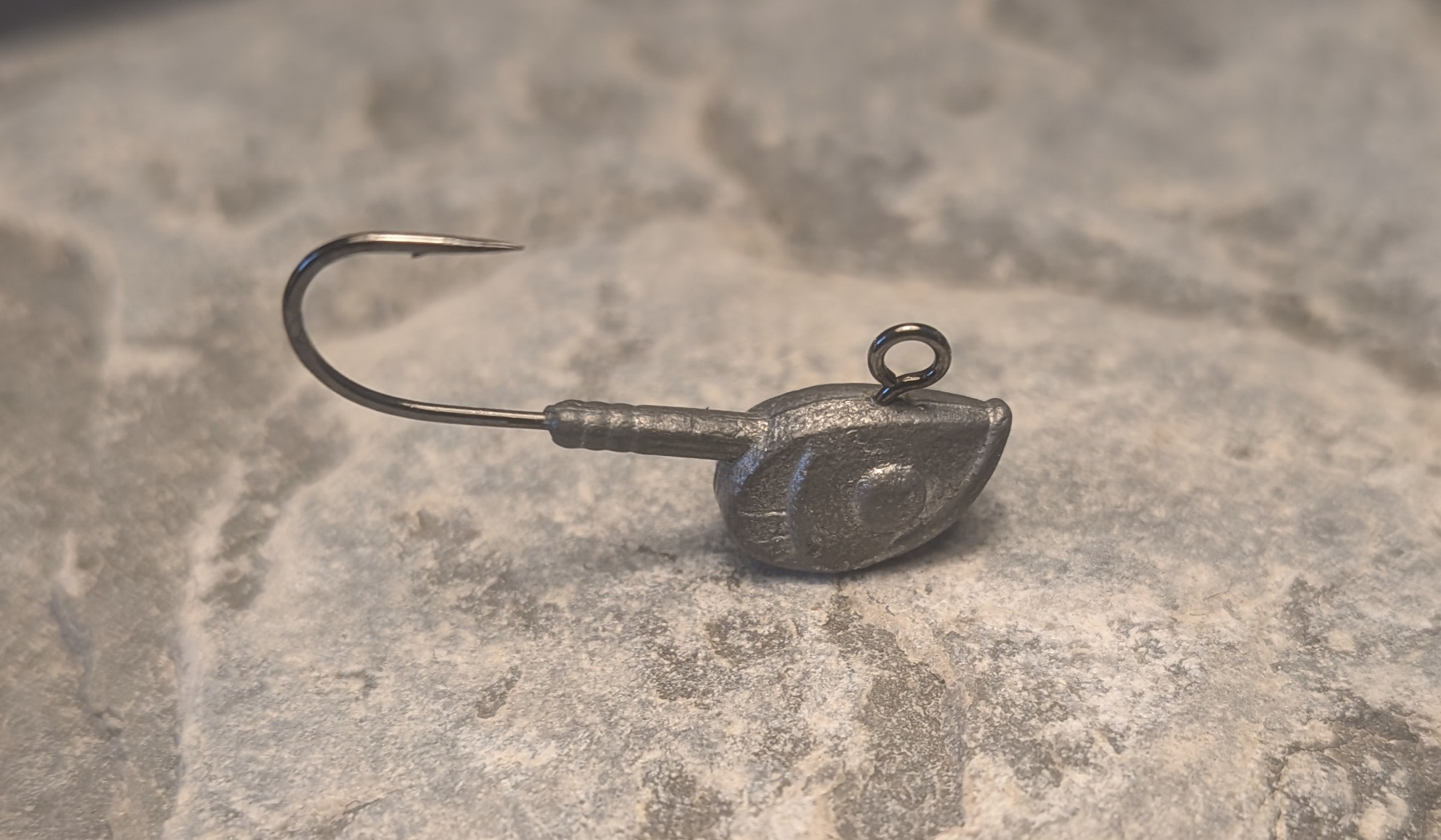
A jig head is one of those bits of tackle that looks almost too simple to matter. A weighted hook, a soft plastic, and you’re fishing. Nothing complicated about it at all.
But in ultralight fishing, simple usually means efficient rather than basic.
A jig head is a fixed system where the weight and hook are locked together. The lure behaves as one unit, sink, movement, and hook position all tied into a single response.
Unlike modular rigs like the Cheb rig or weedless systems like the Texas rig, there’s no separation or delay here. Everything is immediate. What you do at the rod tip is exactly what happens below the surface.
And when fish are active, that clarity and simplicity is often more useful than anything clever.
Why Jig Heads Work So Well
Jig heads work because they give you a direct line into what’s happening underwater.
There’s no lag, no interpretation needed. If a fish touces, or nudges the lure, you know about it straight away. It’s all very honest like that.
Jig heads behave in a way that is easy to read. The sink rate is consistent, the movement is predictable, and the response to rod input is immediate.
That makes them incredibly efficient for covering water.
Each one sits on a slightly different part of the same spectrum. Jig heads are right at the “connection and speed” end of it.
Jig Head Types Explained
This is where things start to separate properly. On paper, jig heads look similar. In the water, they don’t behave the same at all.
Ball Head Jig Heads
Ball Jig Head
The standard. The one most people start with and often go back to.
Ball heads give a neutral, level sink and let you control everything through the rod. Nothing dramatic, nothing exaggerated just steady and predictable.
They’ll do almost anything without really specialising in anything.
Dart Heads
Dart Jig Head
Dart heads introduce direction into the lure’s movement.
Instead of sinking or swimming in a straight line, the lure starts to move off-axis, darting, lifting, or sliding slightly depending on input.
They come into their own when fish are reacting rather than thinking too hard. It’s about a change in rhythm more than anything else.
Fish-Head Jig Heads
Fish-Head Jig Head
Simply jig heads shaped to resemble a small baitfish rather than a plain ball of lead. The idea isn’t to reinvent the rig, just to add a more natural presentation in the water.
In clear or pressured conditions, that slightly more realistic outline can help, especially when fish are following rather than committing. Functionally they fish the same as a standard jig head, but the shape can give a subtle edge when you’re trying to make everything look just a bit more “alive” without changing your setup or technique.
Stand-Up Jig Heads
Stand-Up Jig Head
When fishing extremely slowly and the lure is deliberately fished on the bottom, stand-up jig heads are designed to keep the lure itself positioned facing upwards, rather than lying flat or rolling around.
That small lift changes how the lure behaves underwater, it’s tail off the bottom wiggling in the current, looks more natural, more alert, and more exposed.
Stand up jig heads work especially when bouncing the lure off the bottom using soft flexible lures or scented artificial worms. Most of the action comes from slow lifts, short hops, and letting it settle back down again.
Swim Heads
Swim Jig Head
Swim heads add a subtle built-in movement.
Even without much rod input, they create a slight wobble or kick as they move through the water. Nothing dramatic just enough to stop the lure looking too mechanical.
They’re useful when you want the lure to feel alive without overworking it.
Weedless Jig Heads
Weedless Jig Head
Weedless jig heads are where things start to overlap with other systems.
The wide gape with a hidden hook point allows you to fish through structure and broken ground without constantly snagging.
They’re not completely snag-proof (nothing really is) but they open up areas you simply wouldn’t fish with a standard exposed hook.
This is where jig head fishing starts to blend into Texas rig territory.
Choosing the Right Jig Head Weight
Light heads fall slowly, stay in the zone longer, and give fish more time to react.
Medium weights tend to be the most useful overall enough control without losing finesse.
Heavier setups are more about maintaining contact when conditions get in the way wind, depth, current.
The weight doesn’t just move the lure. It sets the tempo of everything.
How Jig Heads Affect Lure Action
This is one of those things that doesn’t fully make sense until you’ve fished them a lot.
Change the jig head, and the same lure can behave differently, tighter swim, looser roll, sharper drop, slower sink.
Small differences in shape and balance affect how the lure moves through the water more than you’d expect.
After a while, you stop thinking of jig heads as interchangeable and start seeing them as tuning options.
Where Jig Heads Work Best
Jig heads are at their best when you’re covering water or working ground that isn’t constantly snaggy.
They suit:
estuaries
docks and harbours
deeper channels
mixed clean ground
active feeding fish
They’re designed for reading water quickly rather than picking it apart slowly.
Jig Head Fishing Technique
Most of the time, jig head fishing doesn’t need much overthinking.
A steady retrieve, a pause now and then, and letting the lure sink naturally is often enough.
A lot of takes happen on the drop, or just as you start moving the lure again. That transition moment is where things often happen.
The main mistake is doing too much. Jig heads tend to fish better when you let them do their thing rather than trying to overwork them.
There’s a simplicity to them that rewards restraint more than effort.
Jig Head vs Other Rigs
Assortment of Jig Heads and Hooks
Each rig has its own job, and they sit quite neatly on a progression.
Jig Head – Direct, efficient, reactive. Best for covering water and active fish.
Texas Rig – Controlled, weedless, slower. Best for structure and snag-heavy ground.
Cheb Rig – Separated, finesse-driven, slightly unpredictable. Best for pressured fish.
Split Shot Rig – Ultra-light, minimal disturbance, very slow presentation. Best for micro species and extremely cautious fish.
Dropshot Rig – Static, precision-based, ultra-finesse control. Best when fish are holding tight and won’t commit to moving lures.
Put simply:
Jig head = speed and contact
Texas rig = control and structure
Cheb rig = finesse and variation
Split shot = minimalism and patience
Once you see them like that, it stops being about preference and becomes about reading conditions.
When to Use a Jig Head
A jig head is usually the starting point.
If fish are active, moving, or you’re not entirely sure what’s going on, it’s often the quickest way to find out.
It works best when:
fish are feeding or roaming
you need to cover water
conditions are relatively open
you want immediate feedback
When things slow down, or structure starts to dominate, you move down the system.
Jig Head FAQs
What is a jig head used for?
Fishing soft plastics with direct control and a clean, predictable action.
Are jig heads good for beginners?
Yes. Simple to rig, easy to fish, and very responsive.
What weight jig head should I use?
Light for slow, shallow fishing. Heavier for depth, wind, or current.
Jig head vs Texas rig?
Use the jig head for open water. Texas rig for snaggy ground.
Jig Head Vs Cheb Rig
Jig head is direct. Cheb rig gives a slower, more natural fall.
Final Thoughts
Jig heads don’t try to do too much. That’s probably why they’ve lasted so long in different forms of lure fishing.
They give you a direct connection to the lure, and give a very honest picture of what’s happening underneath you.
Once you start combining them properly with other systems, Texas for structure, Cheb for finesse, split shot for ultra-light work they stop being individual setups and become part of a system.
And that’s usually when things start to fall into place a bit more consistently.